A Deep-Dive Into the Results: Overviews of Each Licensing Authority
1st. United Kingdom Gambling Commission (UKGC)
Key Stats
| Total Points | Total % Missing Criteria | Worst At… |
|---|
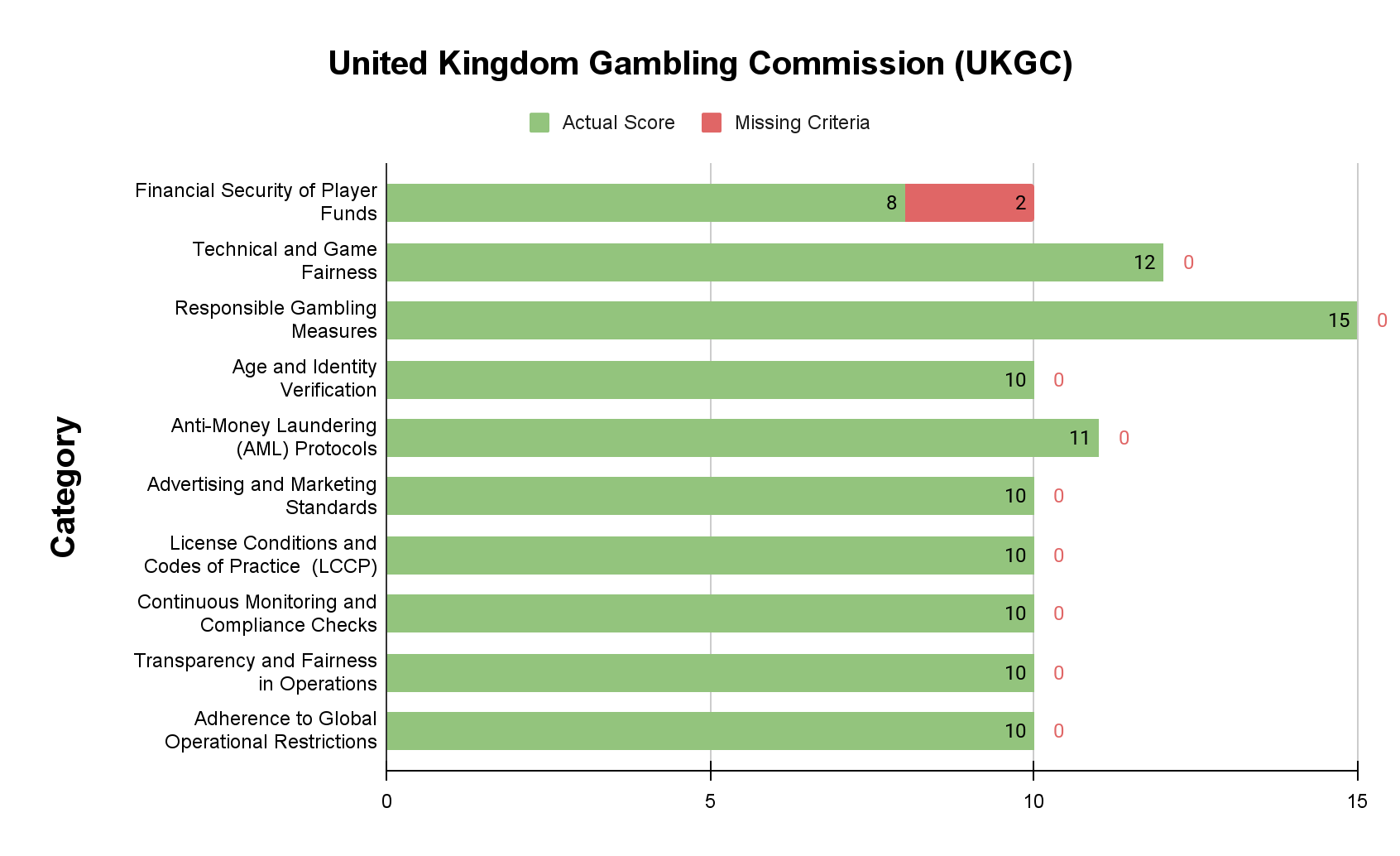
| 106 / 108 | 1.85% | Financial Security of Player Funds |
Who’d’ve guessed it? The Brits come out on top with a resounding 106 points. They lack only two of the criteria we tested for!
We’re not at all surprised. The Brits love things to be tightly regulated; we even hear queuing is like a national sport to those guys.
The only areas in our rubric they didn’t fully satisfy were:
- Real-time Financial Monitoring – Use of real-time monitoring systems to track and manage player funds effectively, ensuring immediate action can be taken if financial discrepancies are detected.
- Guarantee of Insurance Scheme – Presence of a guarantee or insurance scheme that protects player funds against the company’s insolvency.
The first is not entirely necessary, and the second is mostly accounted for by the Segregation of Funds criterion.
Competent. Prescient. And world-leading. If your casino is licensed by the UKGC, you’re all good.
2nd. Gibraltar Regulatory Authority (GRA)
Key Stats
| Total Points | Total % Missing Criteria | Worst At… |
|---|
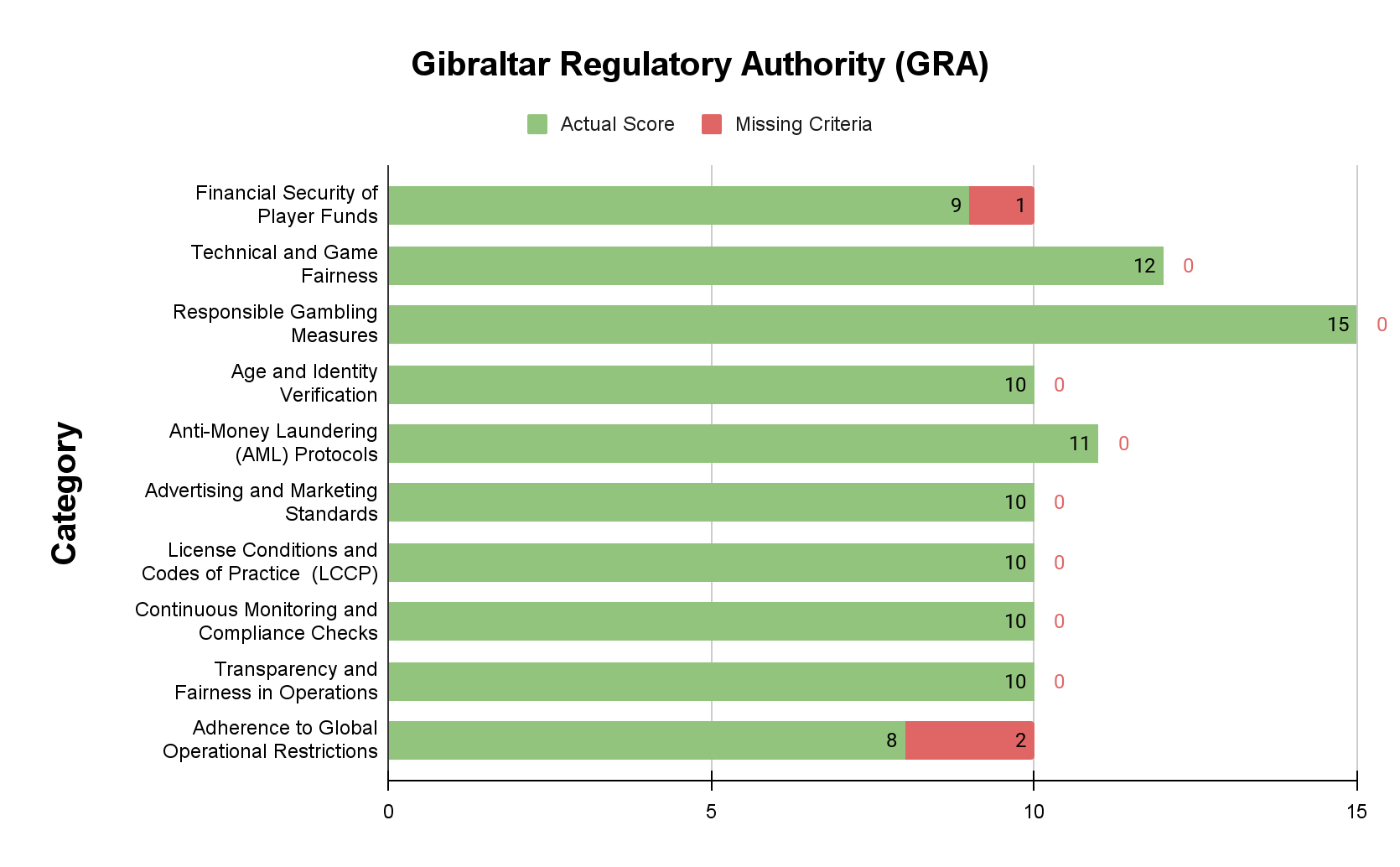
| 105 / 108 | 2.78% | Adherence to Global Operations Restrictions |
The Gibraltese follow close behind with 105 points. As cousins of the British, they emulate the model well, and are world-leaders in their own right.
So where did they fall behind? According to our data, the GRA doesn’t support or participate in global self-exclusion initiatives. These allow players to exclude themselves from all gambling sites across multiple jurisdictions.
It would be great if they could hop on that initiative, as some of us could need that extra help! Overall, though, it’s another cracking effort. Thanks for looking out for us, Gibraltar.
(Joint) 3rd. Danish Gambling Authority (DGA)
Key Stats
| Total Points | Total % Missing Criteria | Worst At… |
|---|
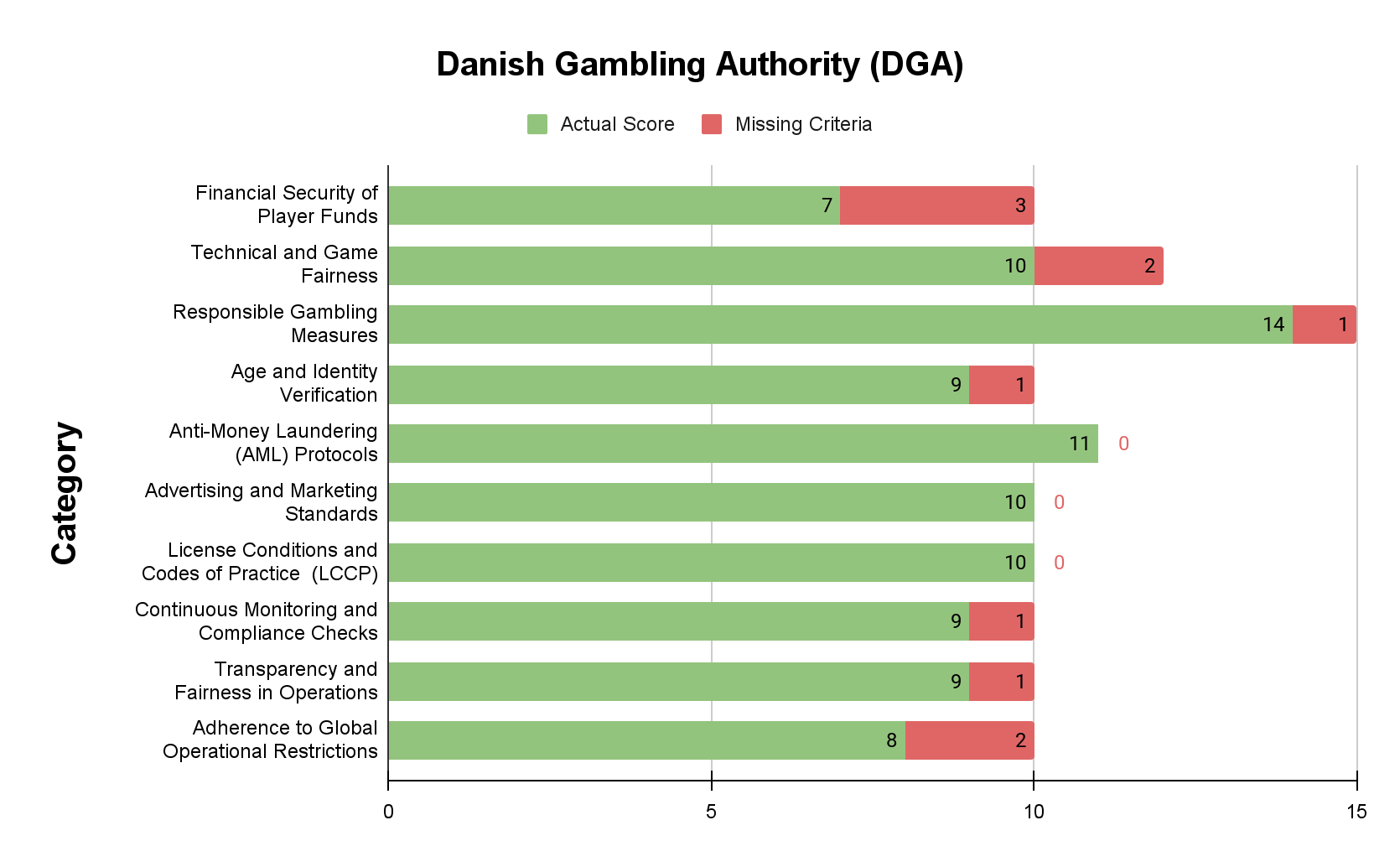
| 97 / 108 | 10.19% | Financial Security of Player Funds |
The Danes may be late to this regulatory lark (at least online), but they’re pretty damn good at it. Coming joint-third with 97 points, they’re competing with the best.
So where can the Danish Gambling Authority improve? Three areas in particular stand out.
- Stakeholder Engagement – Including stakeholders in compliance monitoring just makes sense. If the DGA added this, they’d be able to get insights and feedback from people working in the industry.
- Game Fairness Reporting – We’re sure players would love it if casinos were made to report on the fairness of their games. (We know this is handled at the level of game developers, but what if a sneaky operator tries to manipulate the games?).
- Independent Audits of the DGA – It’s great that they audit the casinos, but what about themselves? Audits should be conducted on the DGA itself to make sure it’s maintaining high standards.
(Joint) 3rd. Swedish Gambling Authority (SGA)
Key Stats
| Total Points | Total % Missing Criteria | Worst At… |
|---|
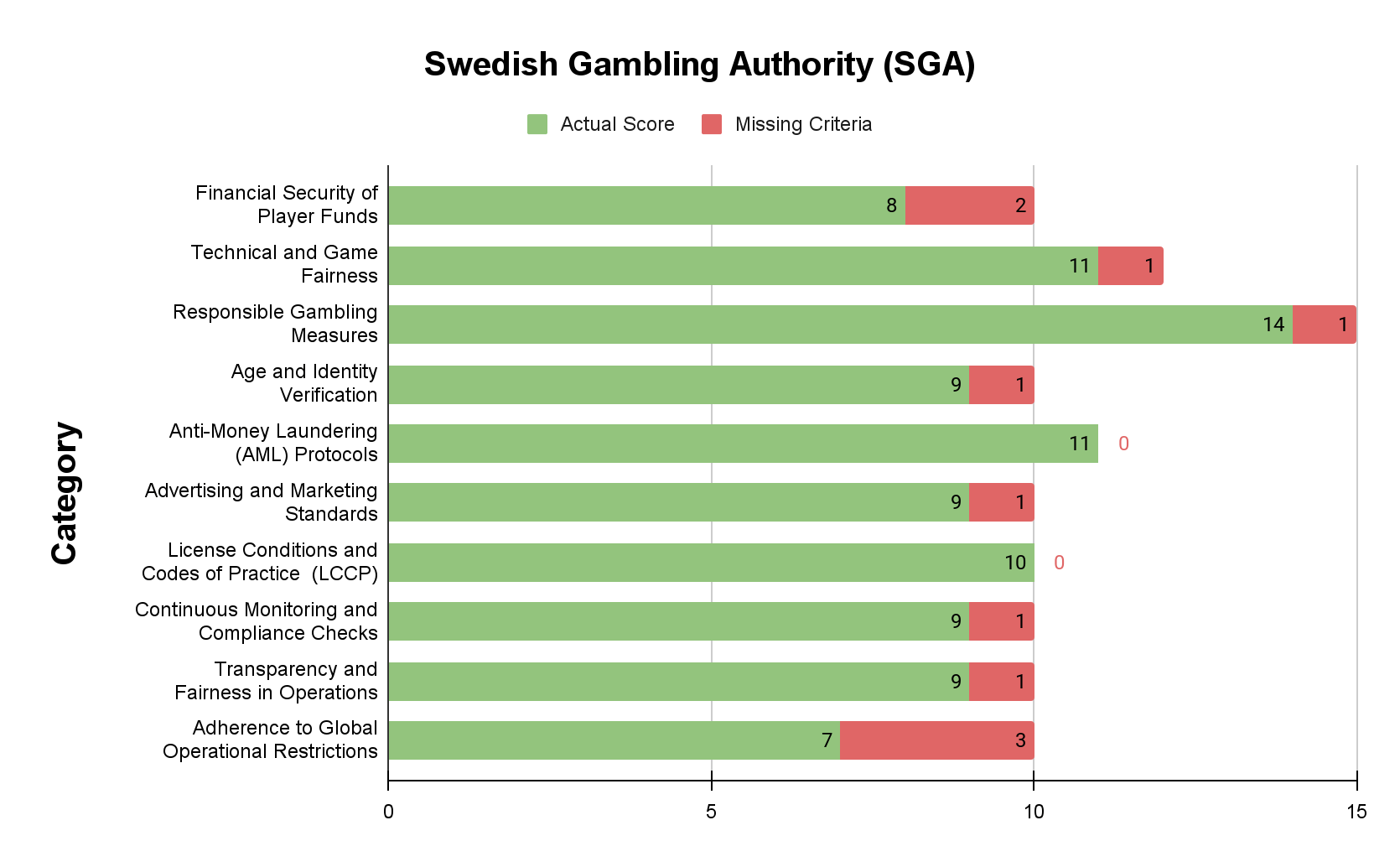
| 97 / 108 | 10.19% | Adherence to Global Operational Restrictions |
The Swedish Gambling Authority suffers from more or less the same deficits as the DGA. Overall, there aren’t any glaring issues. However, improvements can be made in terms of accessibility and transparency.
For instance, while the protections are first-rate, the SGA could communicate them a tad better. This could be done by making a rating system for player fund protections. Simply ranking a casino by basic, medium, or high player protections would help a lot.
The SGA suffers in an area it doesn’t care to help: following global rules. The SGA is exclusive to gambling in Sweden. Whether or not it adheres to restrictions on a global level exceeds its remit.
4th. Malta Gaming Authority (MGA)
Key Stats
| Total Points | Total % Missing Criteria | Worst At… |
|---|
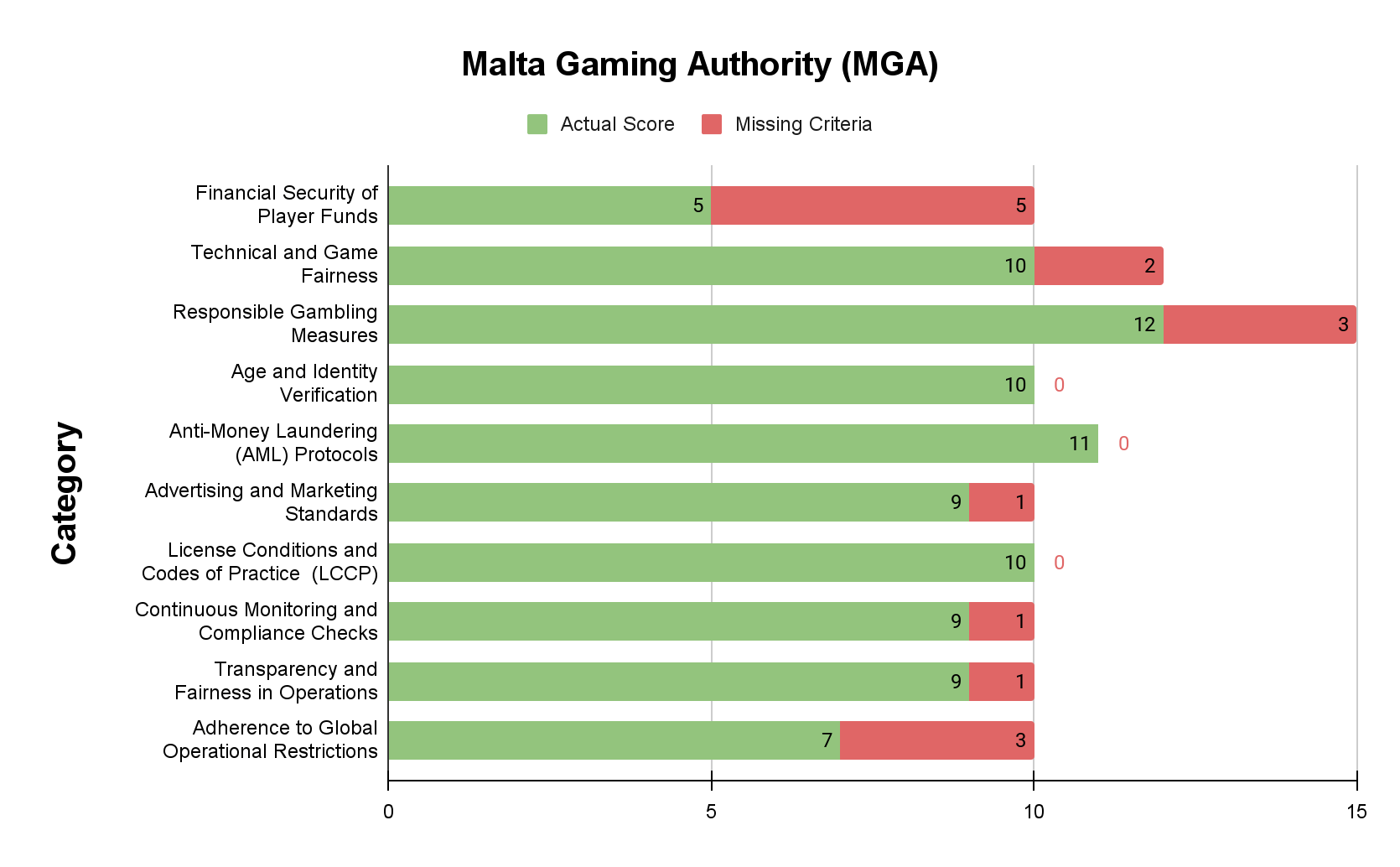
| 96 / 108 | 14.82% | Financial Security of Player Funds |
The MGA is known as a top gambling regulator. But, is its reputation justified? Yes.
With 96 points, the MGA comes near the top of the pack. It is great overall. It got full points for Age and Identity Verification. And it did well in Anti-Money Laundering Protocols. Sadly, it appears that MGA isn’t quite as good at looking after your money!
In our category: Financial Security of Player Funds, the MGA only scored 5 points. Compared to other authorities, such as the GRA (9 points), the UKGC (8 points), and the DGA (8 points), the MGA is below par.
5th. Isle of Man Gambling Supervision Commission (GSC)
Key Stats
| Total Points | Total % Missing Criteria | Worst At… |
|---|
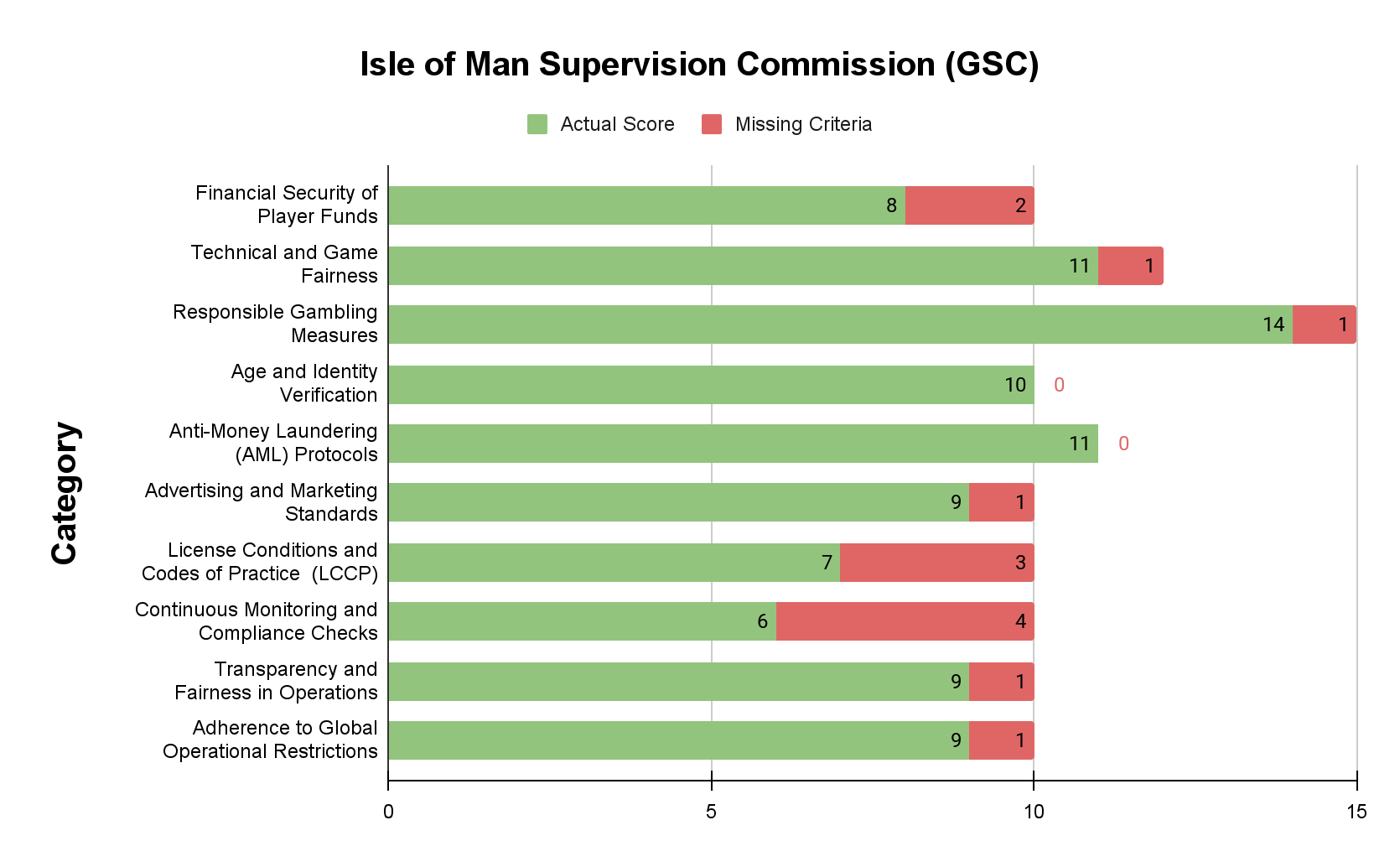
| 94 / 108 | 12.96% | Continuous Monitoring and Compliance Checks |
With 94 points, the GSC came in a close 5th place. This, again, is a worthy effort. However, the GSC falls short in two areas. These are License Conditions and Code of Practice (LCCP), and Continuous Monitoring and Compliance Checks.
Among all the categories we tested for, these are two of the most important. But what does it mean?
Ultimately, the GSC lacks a truly transparent licensing process.
Transparency benefits everyone. We should all be 100% clear on the terms for acquiring a GSC license. And anything less seems a bit shady.
Moreover, the GSC isn’t fantastic at reporting its compliance and enforcement actions. In our opinion, this should be more common. What’s the use of having laws and regulations if we can’t be certain they’re enforced?
6th. Alderney Gambling Control Commission (AGCC)
Key Stats
| Total Points | Total % Missing Criteria | Worst At… |
|---|
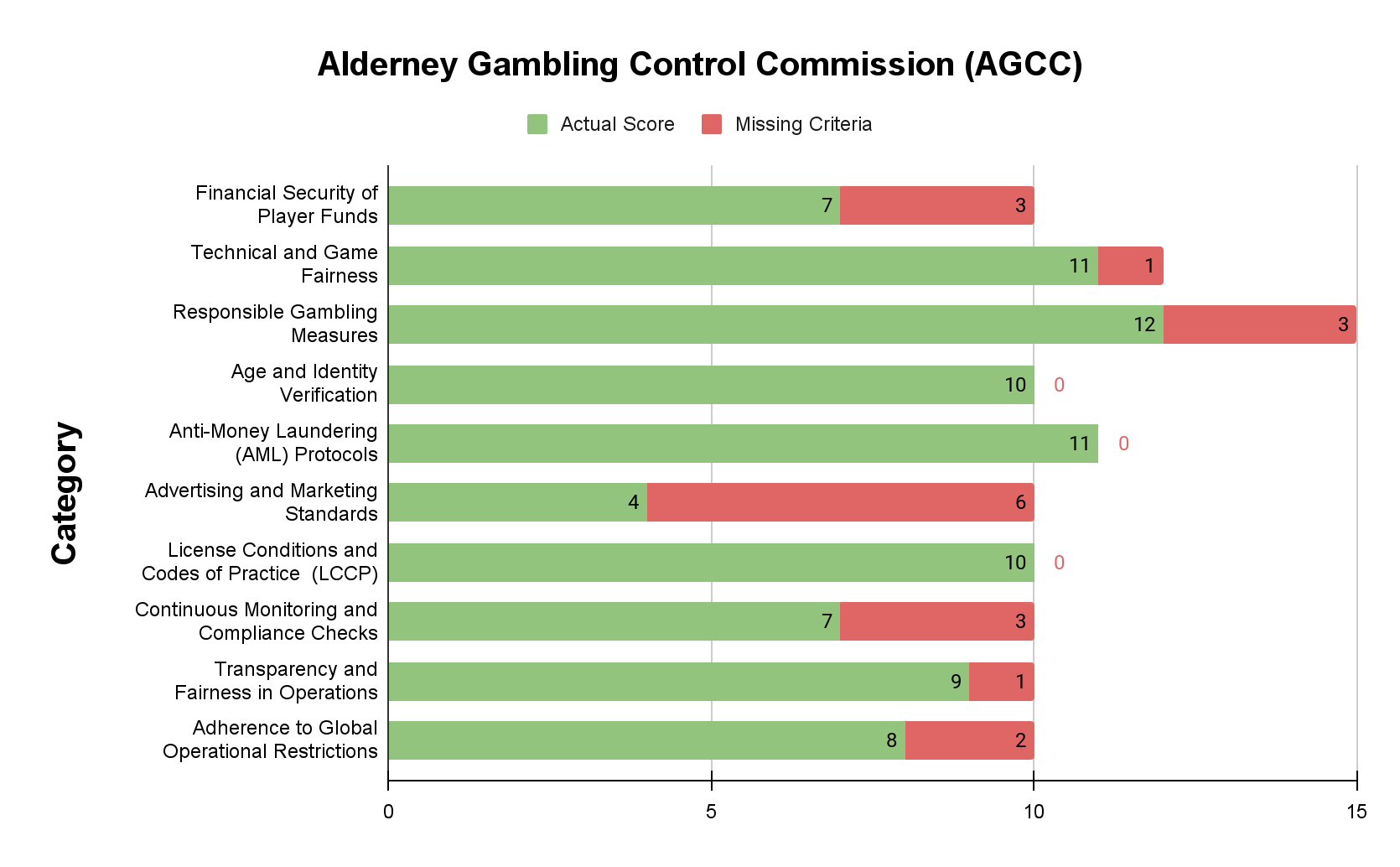
| 89 / 108 | 17.59% | Advertising and Marketing Standards |
At 6th place is the AGCC, with 89 points. We still consider this an admirable effort – especially since its worst performance is in the Advertising and Marketing Standards category.
High standards for advertising and marketing are important, but maybe not as important as other categories, such as financial security and game fairness.
Overall, 17.59% of the criteria are missing. This shows that the AGCC can improve a bit in many areas. But, we think its 6th-place finish is misleading. It’s quite close in standards to the authorities above it in the leaderboard.
7th. Kahnawake Gaming Commission (KGC)
Key Stats
| Total Points | Total % Missing Criteria | Worst At… |
|---|
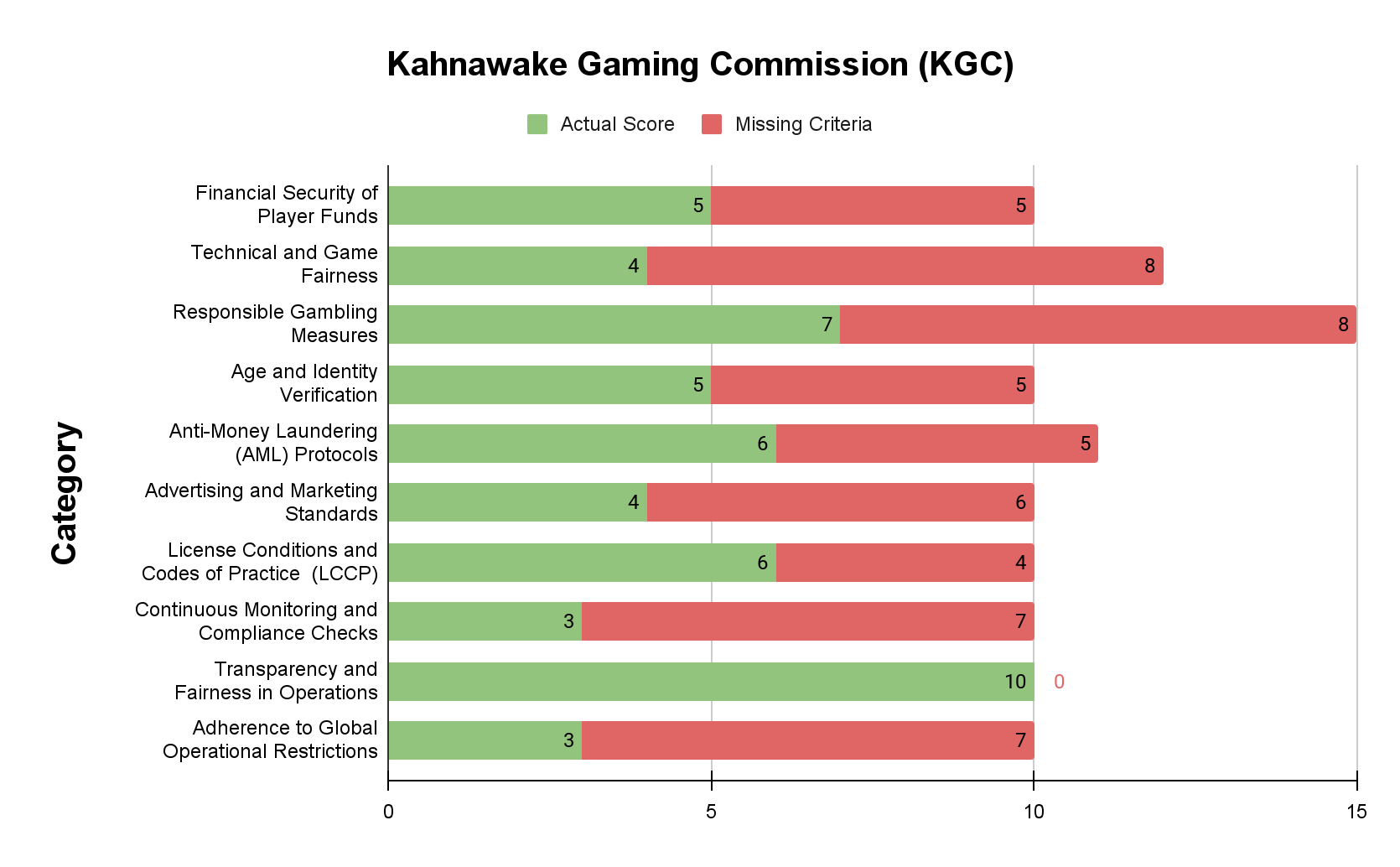
| 53 / 108 | 50.93% | Multiple Categories |
Coming in 7th place is Kahnawake. This is where huge differences begin to appear.
Meeting only 53 of the 108 criteria, Kahnawake has just over half of the player protections we tested for (50.93%).
The KGCs deficits are sweeping, with only one category – Transparency and Fairness in Operations – being adequately legislated for. (And even then, we’re not sure how accurate this finding is – but more on that later!).
In many industries, the US tends to be a lot more like a regulatory Wild West. Kahnawake reflects this trend. Yet recently we’ve seen the emergence of more gambling authorities in the US. It may be the case that the KGC and other US licensors begin to standardize their regulations.
Nonetheless, at present there’s a lot of room for improvement. We suggest caution when playing at a casino licensed by Kahnawake.
8th Curacao eGaming
Key Stats
| Total Points | Total % Missing Criteria | Worst At… |
|---|
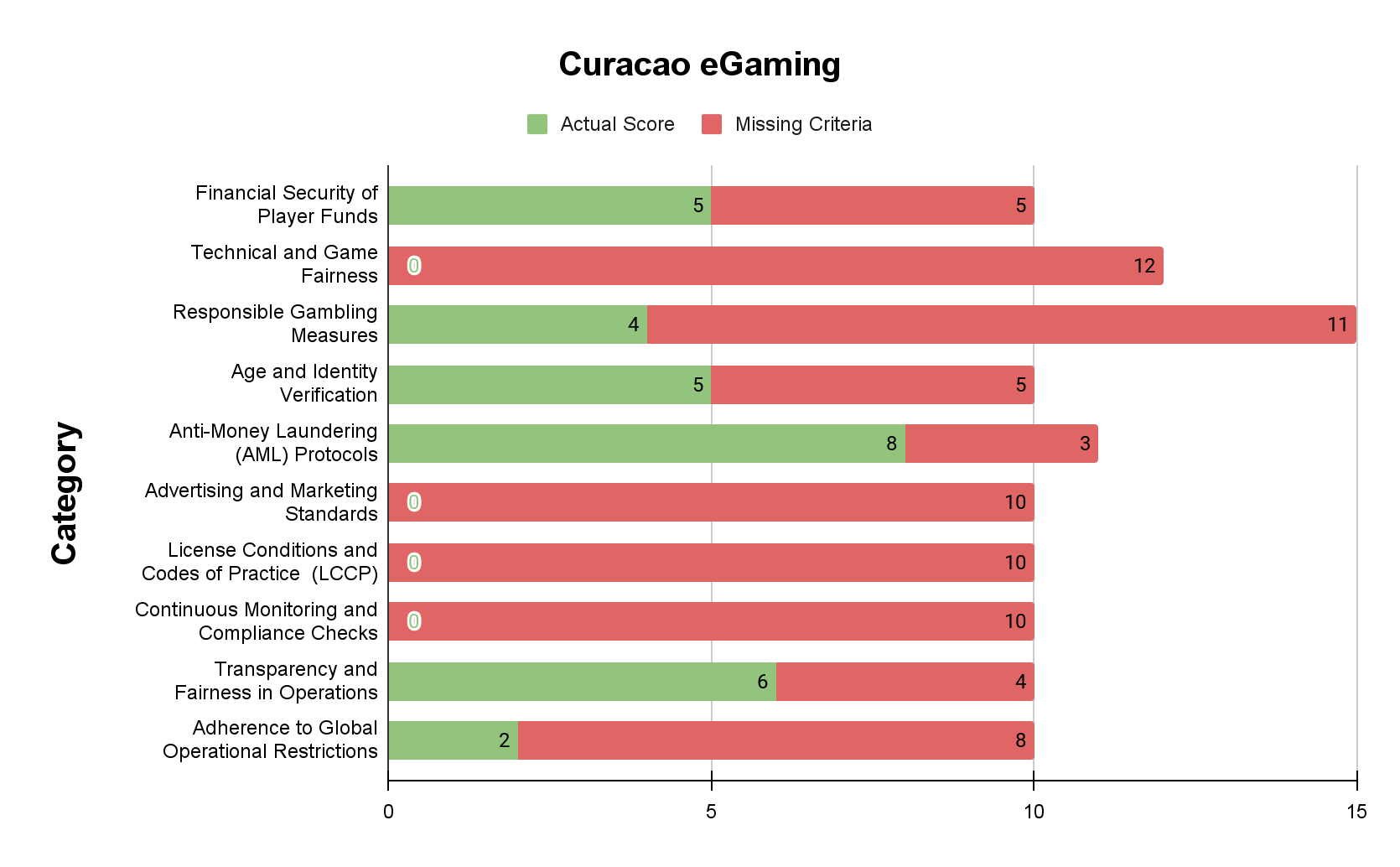
| 30 / 108 | 72.2% | Multiple Categories |
Where to begin with Curacao E-gaming? Well, you’ll be glad to know they’re currently in the process of beefing up their operations. The authority wants to be on par with other leading jurisdictions. And we respect that ambition.
Right now, however, they’re way off. Scoring 0 in 4 of our categories, the authority has come a resounding last place.
Significant improvements can be made in every category – which means they have a lot of work ahead if they want to rival the top licensors.
We recommend that you approach casinos licensed by Curacao with a degree of caution.
Editor’s Comment – In Curacao’s Defense
It’s worth keeping in mind why casinos opt for a Curacao license over other licenses. Getting a license can be expensive! Just take a look at the scatter plot below.
This plot compares the maximum cost of applying for a license and providing services in the first year of a site’s existence.
It compares these costs across all our jurisdictions:
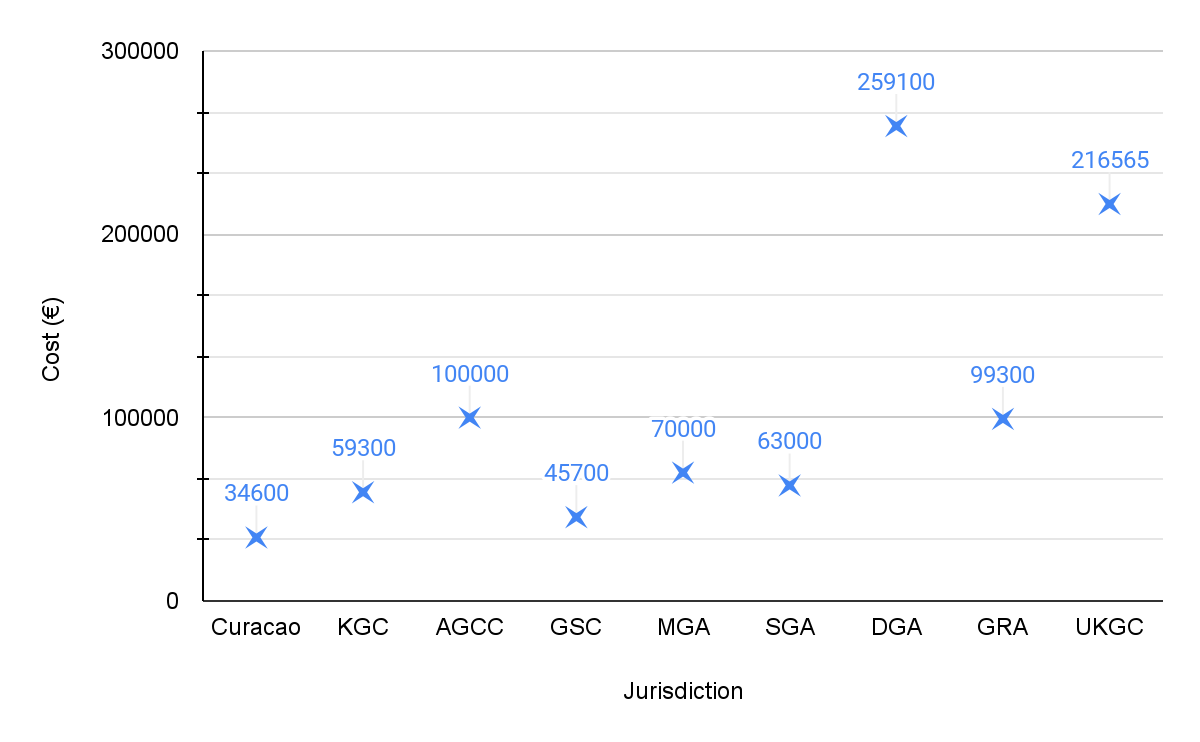
Notice anything significant? Curacao provides a far cheaper alternative than ALL other licensors.
This plays a huge role in ensuring the market isn’t monopolised by one or two large companies. Moreover, it also provides decent protection. The level is low, but it’s useful for players in different – and sometimes, unregulated – markets.